What OpenSidebar does for you
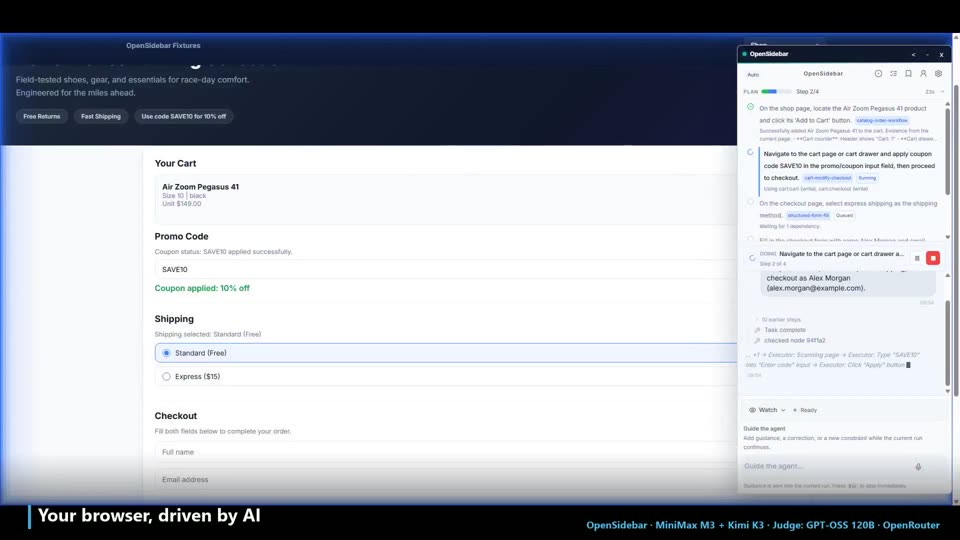
See the side-panel agent complete a checkout, carry information between pages, watch for a change, and operate a business app.
OpenSidebar is an open-source Chrome extension that puts an autonomous agent in your side panel — describe a task in plain English and it sees the page, clicks, types, and carries multi-step work across tabs to done.
Bring your own API key. No subscription or hosted relay — the extension runs in your browser and talks only to the model providers you configure. Optional reliability summaries stay local, off by default, and under your control.
The Chrome Web Store listing is on the way. Until then, build from source and load the unpacked extension — the steps below are the entire process.
A signed listing so anyone can add OpenSidebar straight from Chrome.
Coming soon# clone & build git clone https://github.com/krisshkodrani/OpenSidebar cd OpenSidebar corepack enable corepack pnpm install corepack pnpm run dist # then in Chrome chrome://extensions → Developer mode → Load unpacked → select dist/
Requires Node.js 22+ and a supported provider API key.
Start with the one-minute customer overview, or go under the hood with the developer tour. Both use real recorded runs.
See the side-panel agent complete a checkout, carry information between pages, watch for a change, and operate a business app.
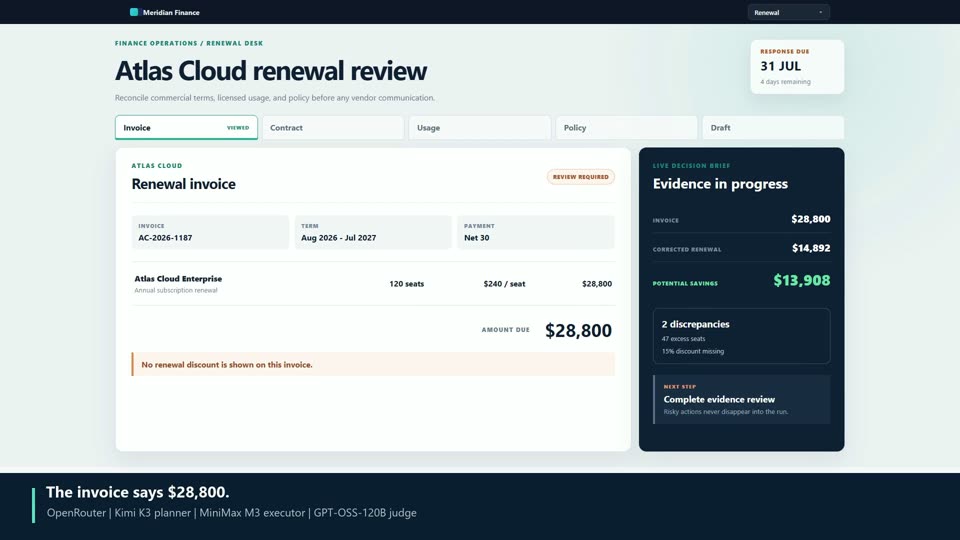
Follow planning, execution, approval gates, verification, trace evidence, and per-task cost across two complex runs.
Real sessions, edited for pacing and captions. Current model details remain visible in each recording; the architecture supports multiple providers and role-specific models.
Every demo above is a recorded run — and every run starts with a plan. The walkthrough page replays four real traces click by click: the prompt, the planner's subtask chain, the executor's actual page actions, and the verifier's verdict on each step, with the model named at every stage.
Four recorded runs: a checkout order · a cross-page inventory lookup · a guarded settings cleanup · a ServiceNow incident
A vision model works from the live screenshot and DOM — reads charts, zooms into fine print, and handles pages that defeat text-only bots.
Clicking, typing, and scrolling, plus file upload and download, tab and window management, and structured read-outs of tables, chart labels, and active filters — the agent gets data out of pages, not just actions into them.
Approvals are on by default, and consequential actions — submitting a job application, sending a message — always pause for you. When the agent works from a draft you approved, the final submit is checked field-by-field against that draft; any mismatch stops and shows you the difference before anything is sent.
A planner decomposes the task, an executor drives it, and a verifier confirms the result — high-risk completions get a second opinion from a dedicated judge model. Stuck runs escalate to a stronger model instead of burning turns.
A local profile you review yourself, per-site skills you record once and reuse, and checkpoints that survive restarts (kept for 24 hours). Sensitive fields are consent-gated per task and encrypted with a key that never leaves your machine.
Point it at a page and it re-checks every few seconds, comparing what actually rendered — then tells you when a price, a status, or a listing changes.
Add a Groq API key in settings and voice input transcribes your words straight into the composer (Whisper large-v3-turbo) — describe the task out loud and let it run.
Every session produces a full-fidelity local trace. Keys live in Chrome storage, and traffic goes from your browser to the providers you configure — your LLM provider, plus Groq if you enable voice — and nowhere else.
OpenRouter is the recommended default; Fireworks is the supported alternative. Your API keys stay in Chrome storage, and page context goes only to the providers you configure. This release has no analytics client, hosted model relay, or first-party telemetry upload endpoint.
The repo ships a full observability workspace: replay any run as a story — plan, nodes, turns, verification — with the judge model's per-criterion reasoning and cost on high-risk completions, then record whether the outcome was actually right. Traces never leave your machine.